Free Handwriting Practice Worksheets
Printable writing practice sheets for print and cursive: alphabet tracing, a page per letter, sentences and blank handwriting paper. All files are free PDFs.
27 pages, 93 KB · A4 version · Updated November 27, 2026
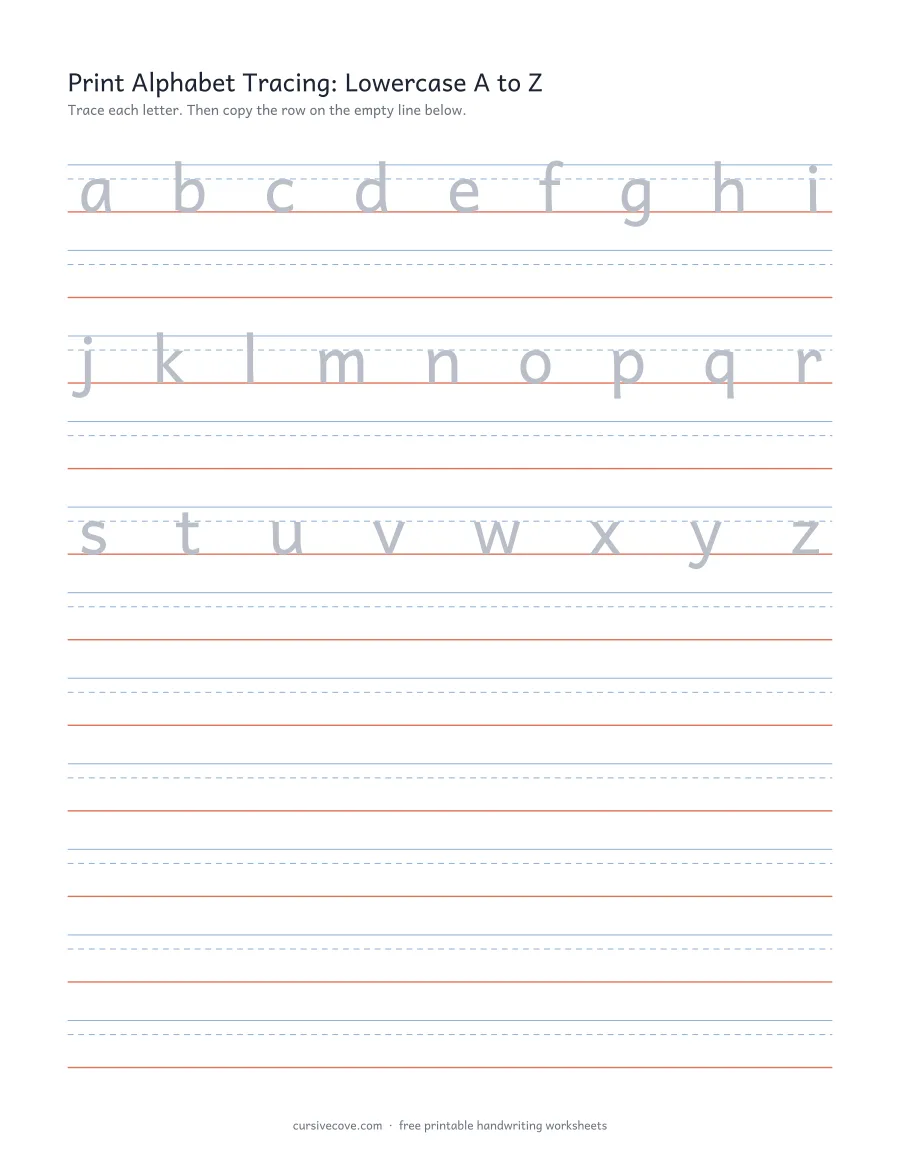
Which sheet should I start with? For a child who is learning letters, print the lowercase tracing sheet. For a child or adult who already prints, go to the cursive section. For free writing, print blank handwriting paper in the right line size.
Print handwriting worksheets
Clear print letters with a single-story a and g, the shapes children see in early readers.
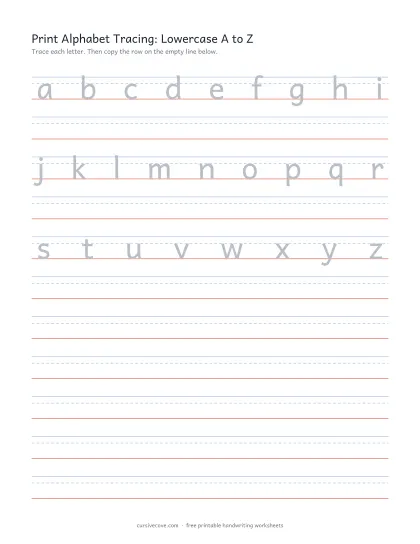
Print Lowercase Alphabet Tracing Worksheet
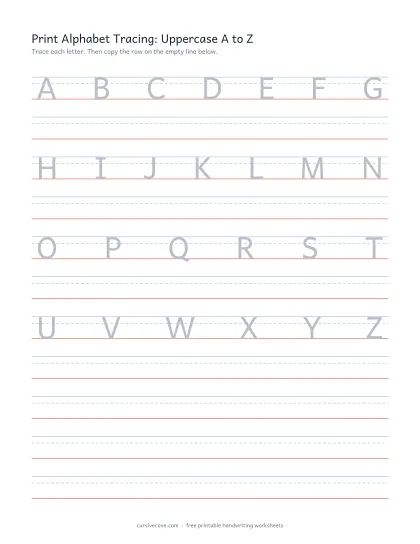
Print Uppercase Alphabet Tracing Worksheet
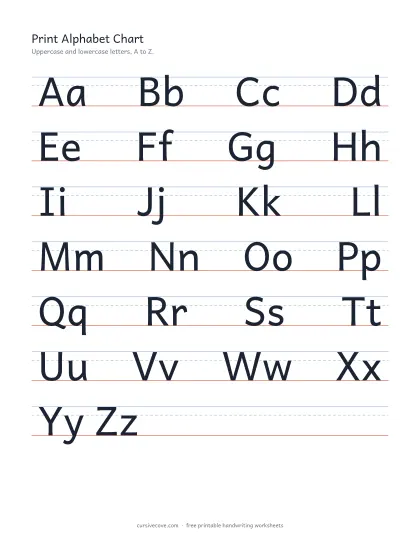
Print Alphabet Chart
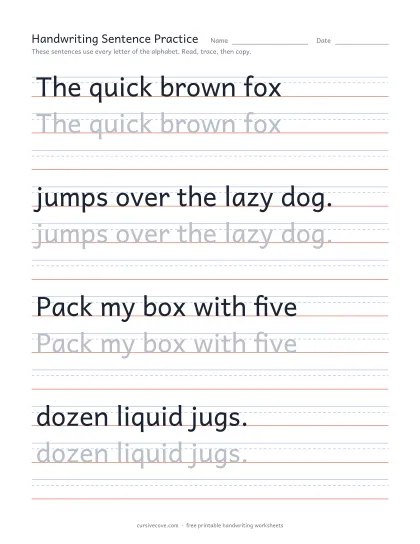
Print Handwriting Sentences Worksheet
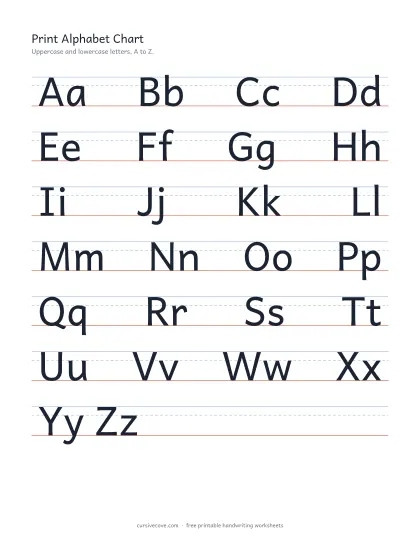
Print Handwriting Worksheets A to Z: Complete Pack
Cursive handwriting worksheets
A selection of cursive sheets. The full list, with one page per letter, is on the cursive worksheets page. Teens and adults: see the handwriting worksheets for adults.
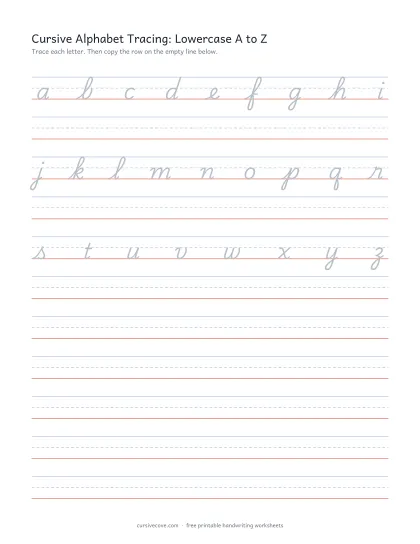
Cursive Lowercase Alphabet Tracing Worksheet
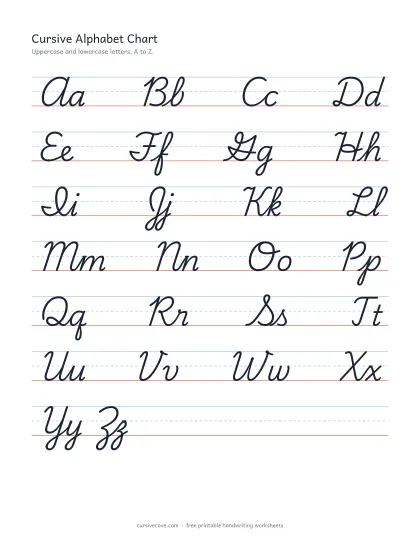
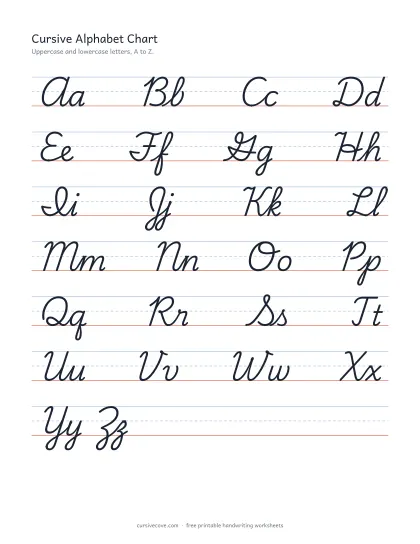
Cursive Alphabet Chart
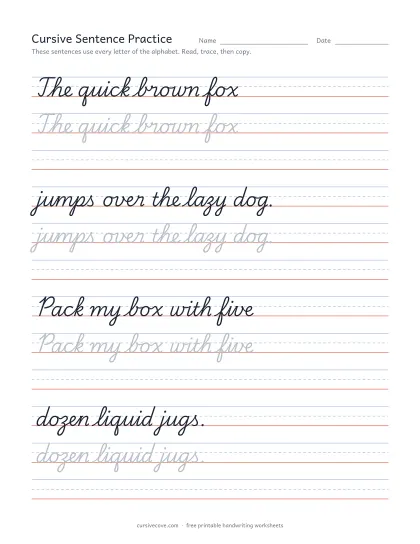
Cursive Sentences Worksheet (Pangrams)
Cursive Worksheets A to Z: Complete Pack
Blank handwriting paper
Three-line paper with a top line, a dashed midline and a red baseline. Print as many pages as you need. Sizes are compared on the handwriting paper page.
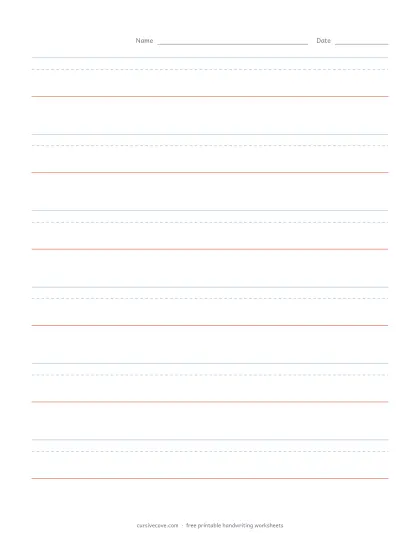
Handwriting Paper: Large Lines (Kindergarten)
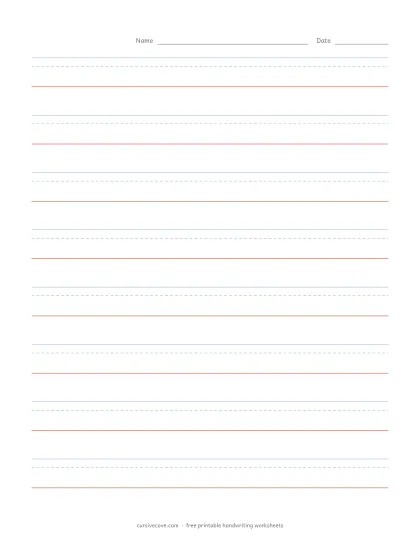
Handwriting Paper: Medium Lines (Grades 1 to 3)
Handwriting Paper: Small Lines (Grade 4 and Up)
Blank Cursive Practice Paper
Practice with your own words
Spelling lists, names, addresses, quotes: type them and print a tracing sheet.
Which line size to choose
| Writer | Line height | Paper to print |
|---|---|---|
| Preschool and kindergarten | About 3/4 inch (19 mm) | Large lines |
| Grades 1 to 3 | About 5/8 inch (15 mm) | Medium lines |
| Grade 4 and up, adults | About 1/3 inch (8 mm) | Small lines |
Line height is measured from the baseline to the top line. Small letters such as a and e fill the lower part, up to the dashed midline.
Four things that make handwriting easier to read
- Size. Tall letters touch the top line, small letters stop at the midline. Consistent size matters more than pretty shapes.
- Baseline. Every letter sits on the red line. Only the tails of g, j, p, q and y go below it.
- Spacing. Leave the width of one letter o between words, and a little air between letters.
- Slant. Upright or slanted both work, as long as every letter leans the same way.
Pencil grip and posture
Hold the pencil between the thumb and index finger, resting on the middle finger, about an inch from the tip. Keep both feet on the floor and use the other hand to hold the paper. Right-handed writers tilt the top of the page to the left; left-handed writers tilt it to the right and hold the pencil a little higher so they can see what they write.
Frequently asked questions
What are handwriting practice worksheets?
Handwriting practice worksheets are printed pages with guide lines and model letters. The learner traces the model, then copies it on an empty line. They are used to teach letter shapes, size, spacing and, in cursive, how letters join.
What line size should I print?
Use large lines (about 3/4 inch) for preschool and kindergarten, medium lines (about 5/8 inch) for grades 1 to 3, and small lines (about 1/3 inch) for grade 4 and up, teens and adults.
How can I improve my handwriting as an adult?
Slow down, write a little larger than usual, and practice for ten minutes a day on lined paper. Start with the lowercase alphabet, fix the two or three letters that are hardest to read, then copy full sentences. Most adults see a clear difference within a few weeks.
Should children learn print or cursive first?
Most US schools teach print first, in kindergarten and first grade, and add cursive in second or third grade. Print letters match the letters in books, which helps early reading.
How often should a child practice handwriting?
Short daily practice works best: 10 to 15 minutes a day, four or five days a week. Stop while the writing is still careful. Tired hands practice mistakes.