Cursive Alphabet: Cursive Letters A to Z
The cursive alphabet has 26 letters, each with an uppercase and a lowercase form. See every cursive letter below, print the chart as a reference, or open a letter for step-by-step directions.
1 page, 70 KB · Updated November 27, 2026
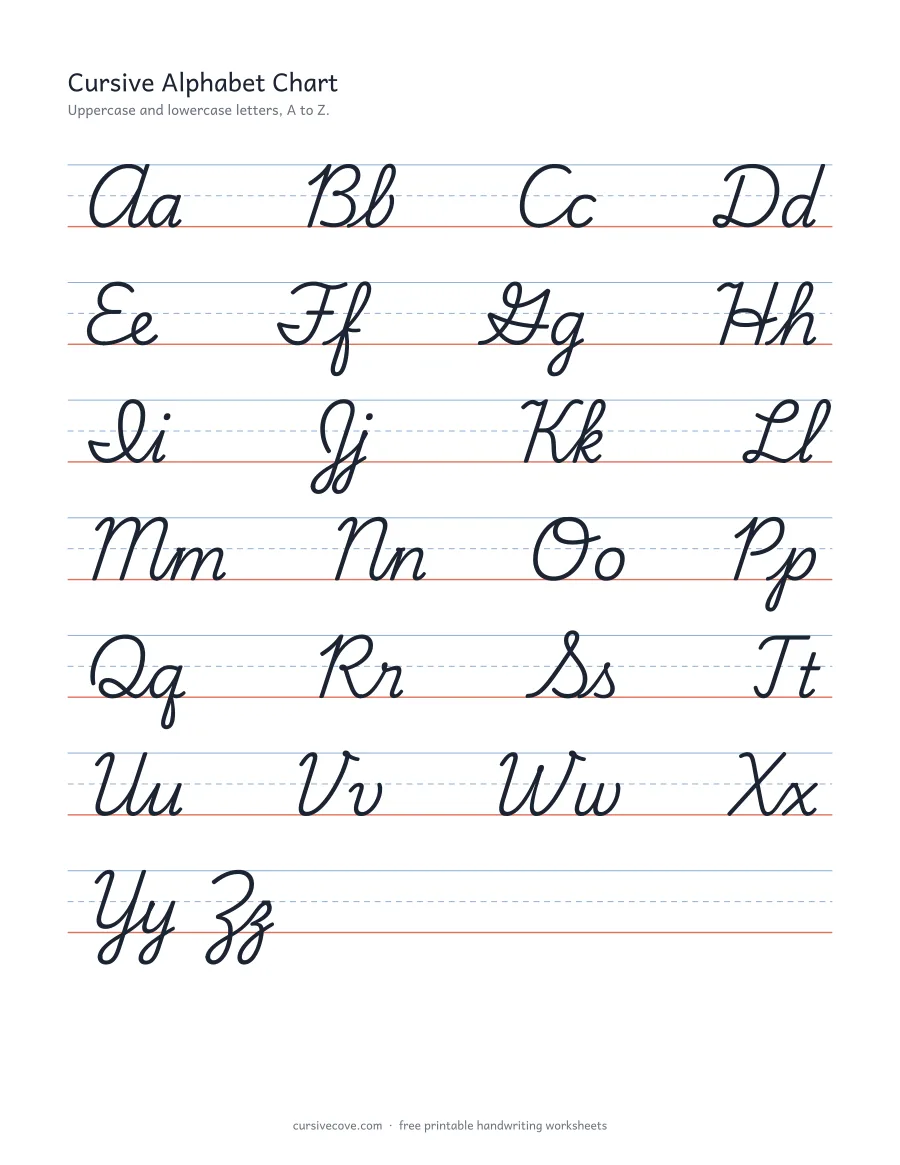
Cursive alphabet worksheets to print
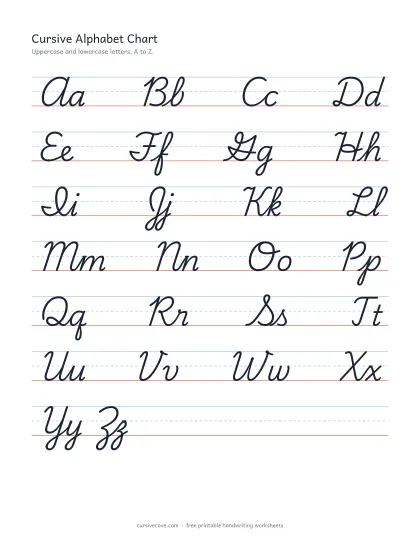
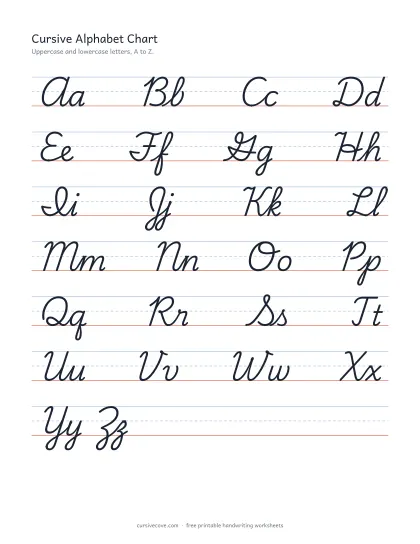
Cursive Alphabet Chart
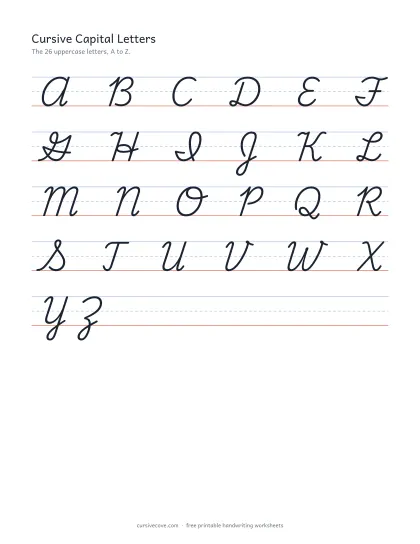
Cursive Capital Letters Chart
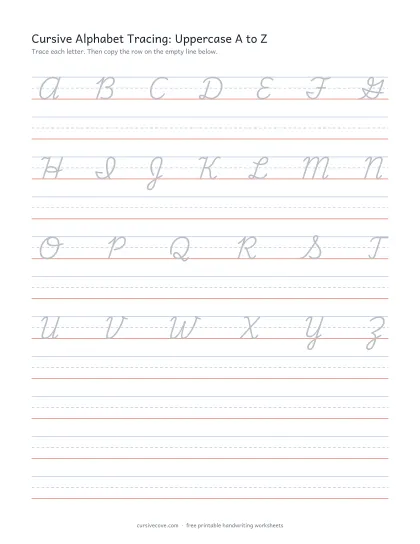
Cursive Uppercase Alphabet Tracing Worksheet
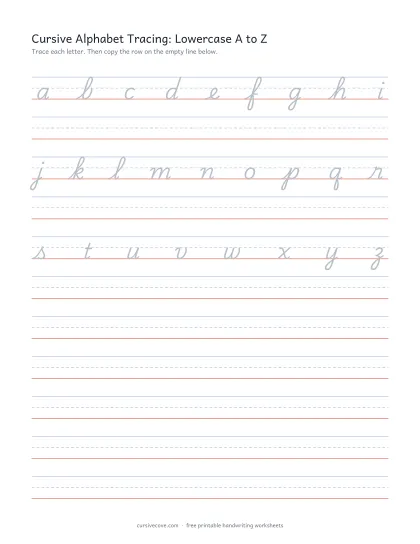
Cursive Lowercase Alphabet Tracing Worksheet
Cursive Worksheets A to Z: Complete Pack
Cursive letters A to Z
Each letter has its own page with directions for the capital and the lowercase letter, common mistakes and a practice worksheet.


The lowercase cursive alphabet
Lowercase letters do most of the work in cursive. Every one of them ends with a stroke that leads into the next letter. For 22 letters, that stroke leaves from the baseline. For b, o, v and w, it leaves from the midline.
Seven letters go below the baseline: f, g, j, p, q, y and z. Seven letters reach the top line: b, d, f, h, k, l and t (t stops a little lower). The other letters stay between the baseline and the dashed midline.
The uppercase cursive alphabet
Every capital is as tall as the letters l and h and reaches the top line. Three capitals also drop below the baseline: J, Y and Z. Capitals are used far less often than lowercase letters, so teach them after the lowercase alphabet, starting with the ones a child needs for their own name. The cursive capital letters page shows all 26 with a short description of each.
How to use the alphabet chart
- Print the chart and keep it in sight during every practice session.
- Trace the alphabet once on the lowercase tracing sheet as a warm-up.
- Practice one new letter with its own worksheet, then write three words that use it.
- Review on Friday by writing the alphabet from memory on blank cursive paper.
Want sheets for whole words? See all cursive worksheets or make your own with the worksheet generator.
Frequently asked questions
How many letters are in the cursive alphabet?
The cursive alphabet has the same 26 letters as the print alphabet. Each letter has an uppercase and a lowercase form, so there are 52 shapes to learn.
Which cursive letters look most different from print?
In lowercase, the letters b, f, r, s and z change the most. In uppercase, G, I, J, Q, S and Z look quite different from their print forms. Traditional capital Q, for example, looks like a large number 2.
Which cursive letters are the hardest?
Learners most often struggle with lowercase b, f, r, s and z, and with capitals G, Q, S and Z. They are harder because their shapes differ from print and because b, o, v and w join the next letter from the midline.
Should I learn uppercase or lowercase cursive first?
Learn lowercase first. The great majority of letters in normal text are lowercase, and lowercase letters teach the joining strokes. Add capitals once the lowercase alphabet is steady.
Is there one correct cursive alphabet?
No. Zaner-Bloser, D’Nealian, Palmer and other programs each draw a few letters differently, mostly capitals. All of them are accepted. The charts on this page follow traditional American school cursive.